
Operating Readiness Review
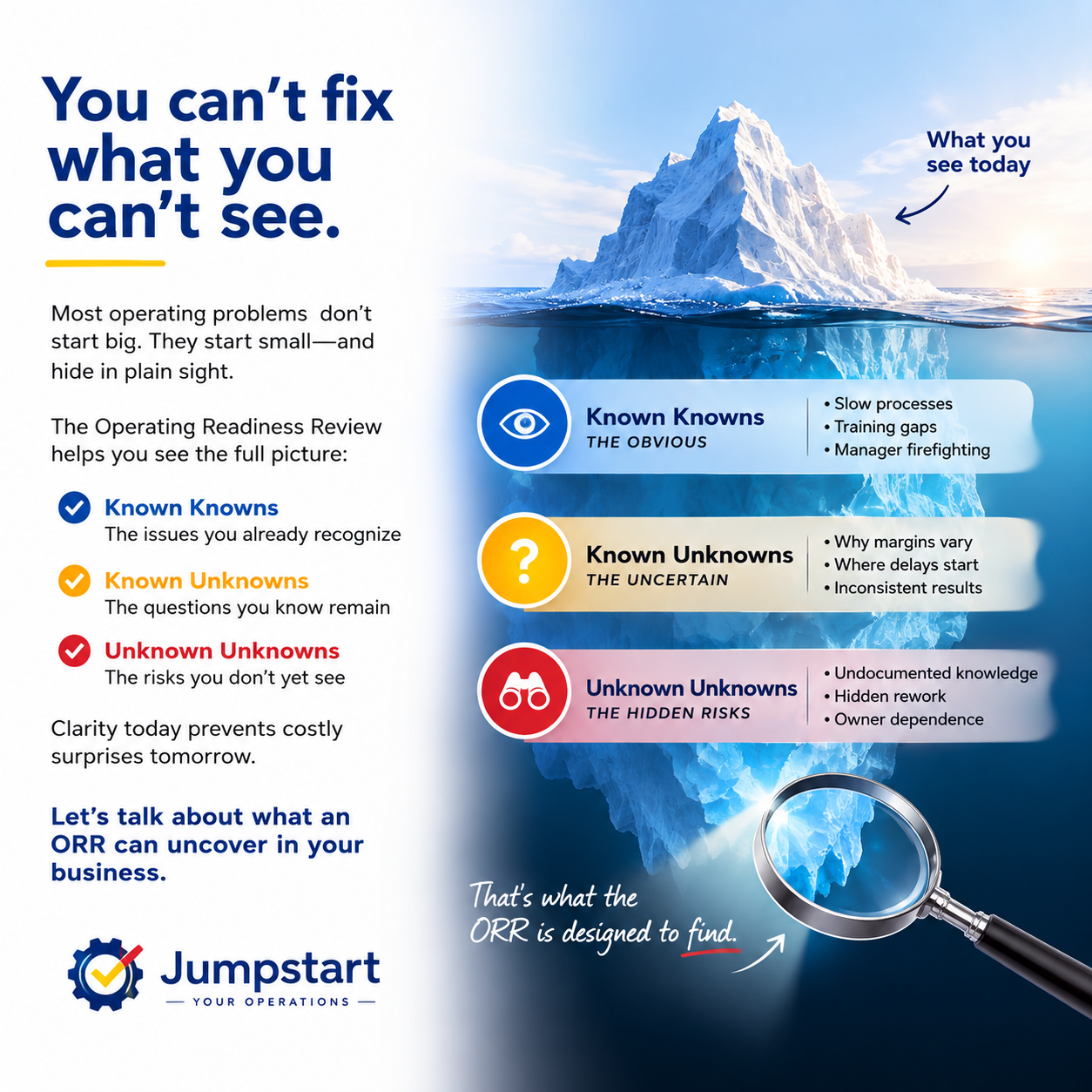
You Can't Fix What You Can't See.
You fixed it. Why is it back?
You explained the procedure. Retrained the team. Put a manager on it. For a while, things improved. Then the same problem returned—and landed back on your desk.
What if the problem you keep fixing is only the part you can see?
The Operating Readiness Review examines what sits beneath the symptoms, so you have a clearer basis for your next decision.
We start with a conversation and decide together whether a review makes sense.
Clarity Before Cost.
The ORR defines what deserves attention, what already works, and what does not need a rebuild. Evidence controls the next decision.

Beneath the symptom
Three Layers Shape the Real Problem.
Each layer changes the solution. The ORR puts all three in view.
Known Knowns
Confirm the problems your team already sees and measure their effect.
Known Unknowns
Answer the questions your leaders recognize but cannot yet resolve.
Unknown Unknowns
Expose hidden risks, contradictions, and controls that fail beneath the surface.
How the review works
We Start With the Problem You See.
We start with the problem you see, what you have tried, and its effect on the business. Together, we define the review scope and identify the operating materials available.
We examine the agreed procedures, manuals, training materials, checklists, and related records. We distinguish supported findings from assumptions and unanswered questions, then connect material gaps to their business consequences.
Who participates
Your team retains authority over the next step.
Owner or Executive Sponsor
Defines the decision and sets the scope.
Operations and Training Contacts
Supply current materials and clarify how people use them.
Jumpstart
Conducts the review and impact analysis. Your team retains authority over the next step.
What you receive
Conclusions You Can Trace to Evidence.
You receive a Diagnostic Findings Packet and Status Quo Impact Study, with priorities and a practical roadmap. We discuss what to preserve, what to correct, and what needs further investigation.
- Operating Readiness Score and plain-language assessment
- Executive diagnosis tied to evidence
- Prioritized findings and immediate decisions
- Practical roadmap for the next right step
- Evidence workbook that supports each conclusion
- Clear distinction between what to preserve and what to correct
The ORR fits when
You Sense the Strain but Do Not Trust the Diagnosis.
- The same problem returns after each fix.
- Locations produce different results from the same standard.
- A large project feels premature without proof.
- Leaders disagree about the cause or first priority.
The value to your business
A Better Decision Is the Immediate Return.
The immediate return is a better decision: a clearer scope, a more useful priority, or an expense you avoid because the evidence points elsewhere. We do not present unverified savings as results. What keeps recurring — and what makes it worth understanding now?
Let's Talk